Published February 9, 2026
Prop Firm Rules Explained: The Complete Guide for Traders in 2026
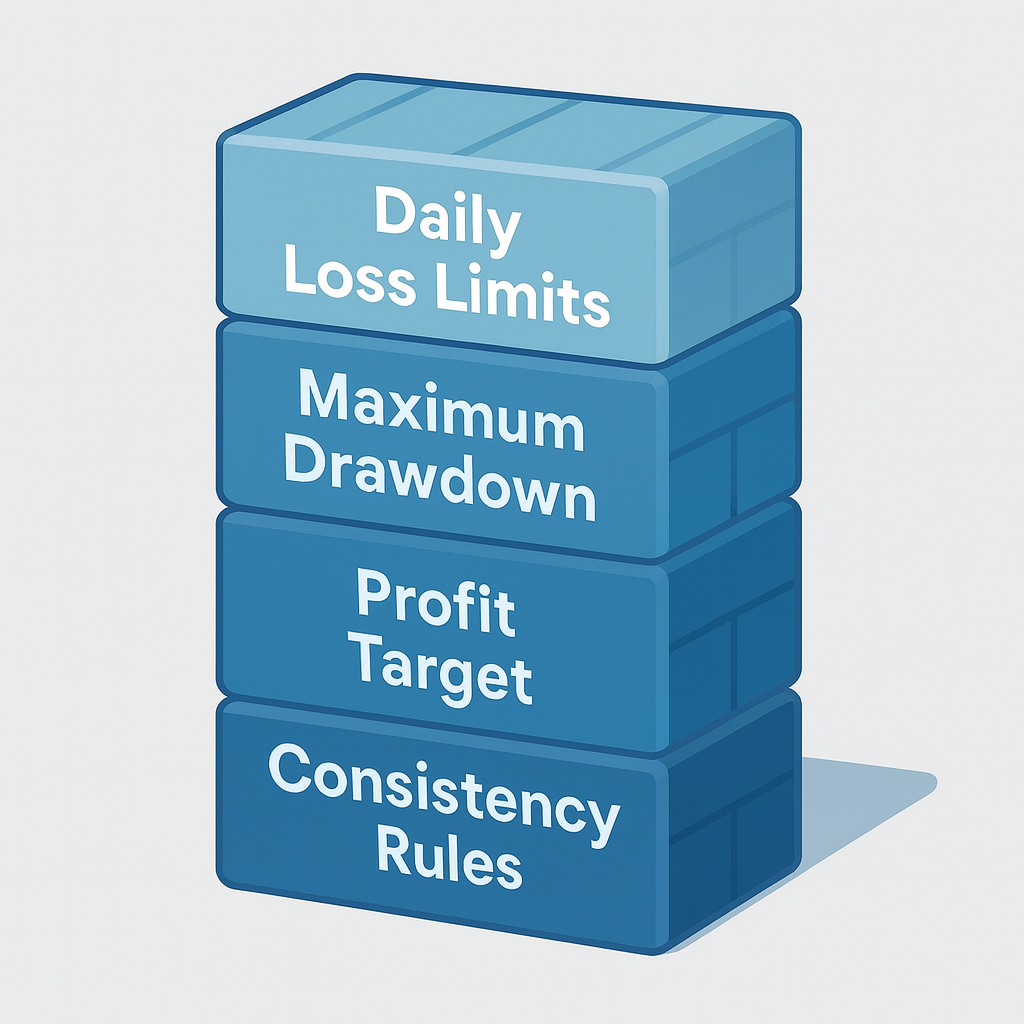
Every prop firm has own rules, although there are standards in rules like consistency, profit target, drawdown. The concepts are similar, the differences are only numbers in rules. Traders should know the rules explicitly to carry their positions comfortable zone. Through rules, firms need secure their capitals while traders can exchange pairs with discipline. There are rules such as daily drawdown, maximum loss, consistency, these could vary according to account sizes, account types, number of phases. All rules covered below to explain one by one.
What Are Prop Firm Rules?
Prop firms rules are constraints and trading conditions while providing capital for traders. These rules are designed to save firms' equities and test the traders' risk management.
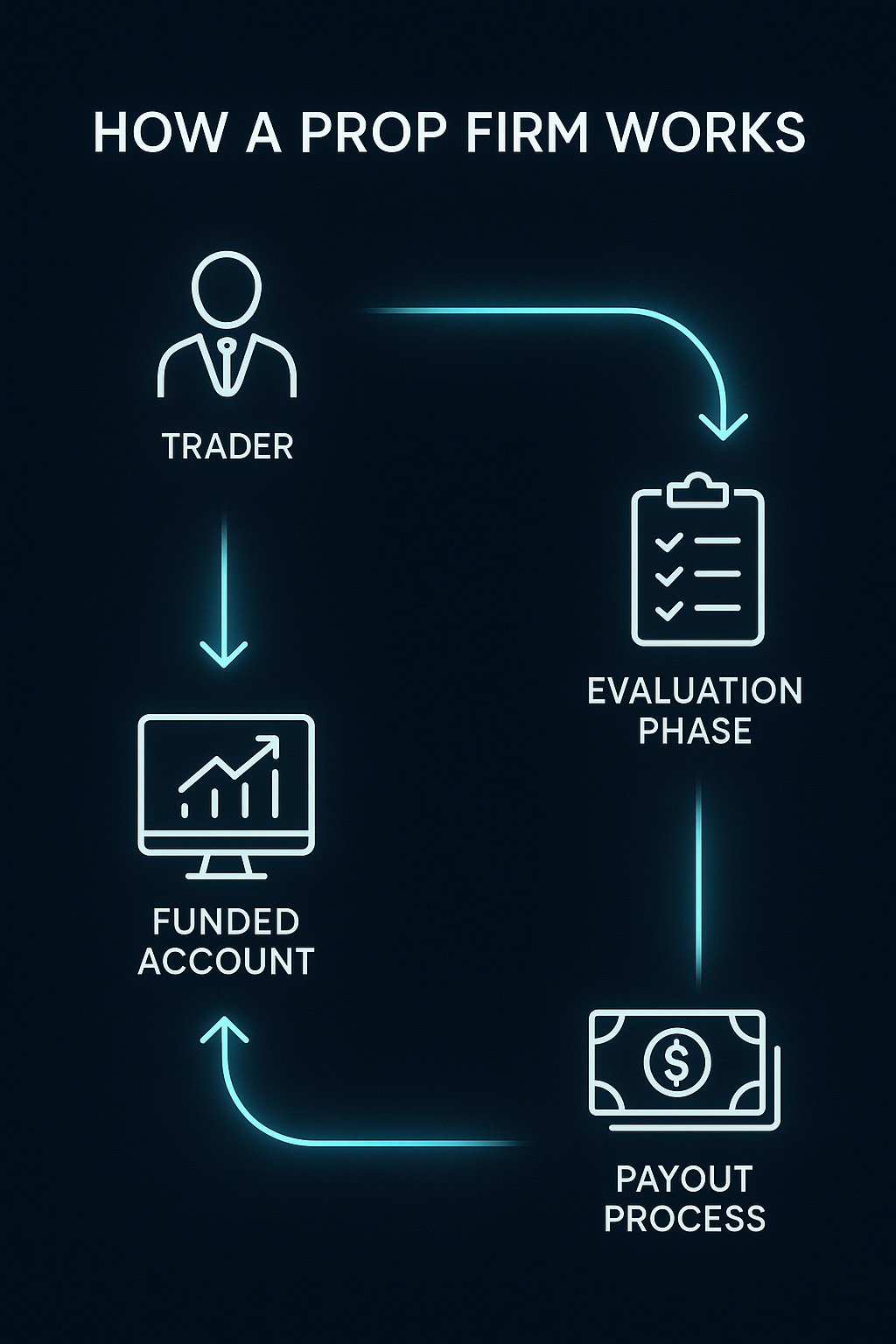
After you purchase a challenge, you can trade the firms' capital, of course, it is valid unless the rules are violated. When you breach the rules, your account can be terminated.
The common rules in prop firms:
- Drawdown limits: Curbs daily and total loss
- Profit Targets: Ratios to be qualify the funded
- Transaction limits: News, weekends, lot sizes
- Consistency: Maximum profit ratio within a day
- Time constraints: Minimum trading days and maximum time limit
Traders continue to trade without knowing the rules as a result of this they violated. After violation:
- in challenges, lose your fee paid
- in funded, account is terminated, can't withdraw profit
Types of Prop Firm Rules
Prop firm rules can be examined under five main categories: drawdowns, consistency, profit targets, transaction constraints and time based rules. Every category is designed to manage different risk. Let's analyze one by one.
1. Drawdown rules
The most crucial part of rules is drawdown rules. It consists daily drawdown and maximum drawdown. After you breach drawdown rules, your account will be cancelled.
All firms enforce the rules with different type for drawdowns. It has variety such as trailing and static. Users need to be careful about rules related to the drawdown since these rules can vary firms to firms.
Prop firms apply drawdown with two types:
- Daily drawdown:
The ratio of the maximum loss within a day. The most of firms hold it around 4%. Example of static drawdown limit:
- Account size: 100,000$
- Daily drawdown limit: 5%
It means maximum amount of daily loss equals 5000$.
- Maximum drawdown:
The total amount your account balance could decrease from its starting balance or peak value. It typically ranges between 8% and 12%.
Example of trailing drawdown limit:
- Account Size: 100,000$
- Maximum drawdown limit: 10%
- Peak equity level: 112,000$
When the account hits less than 112,000$, maximum drawdown is violated.
- Static vs Trailing Drawdown:
We felt the need to create a separate heading for static and trailing drawdown mentioned before, which are the most confusing rules.
- Static Drawdown:
- Calculated according to starting balance
- Immutable
- Trader-friendly
- Trailing Drawdown:
- Calculated according to highest balance
- Shifts up when profit, never back
- Reset Times of Drawdown:
When does the daily drawdown reset to zero? Also, traders should know the their reset time of drawdowns. It differs firm to firm:
- End of Day (EOD): Generally, 22:00 EST
- Rolling 24-hour: Based on the last 24 hours
- Balance-based: Calculated according to the starting balance of day
- Equity-based: Calculated according to the instant equity
2. Consistency Rules
Consistency rule is the most discussing one through the rules. This rule allows traders to prove they are not gamblers.
What is the Consistency Rule in Prop Firm Trading?
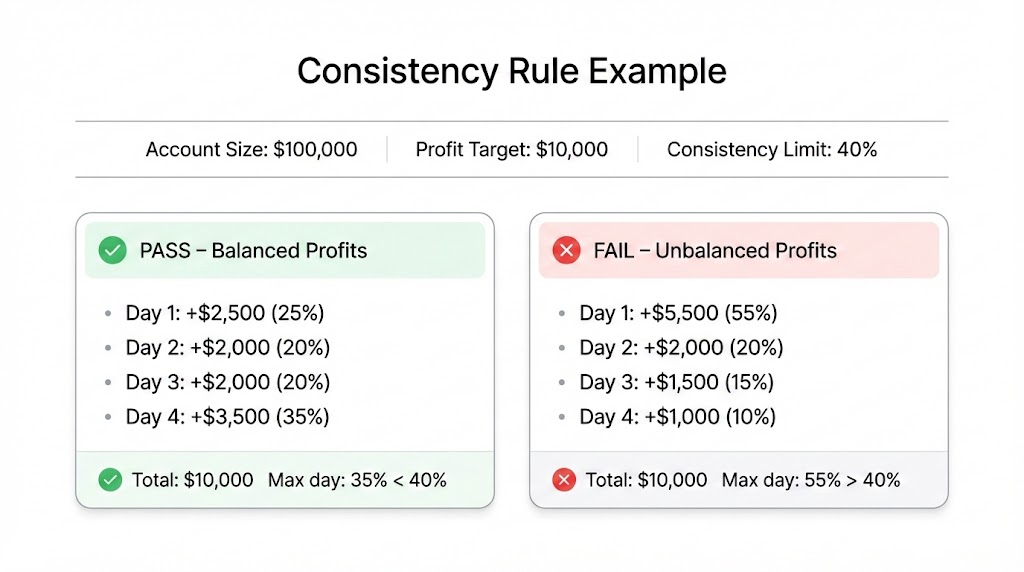
The consistency rule guarantees that trader made a profit in the continuously instead of a day. Usually, it holds 20-35%.
Why the consistency rule is exist? Firms seek the traders are successful contrary lucky one. It does not show the real trading skills, if the trader pass the challenge in a day.
How is the consistency rule calculated?
- Account Size: 100,000$
- Profit Target: 10% (10,000$)
- Consistency Rule: 40% daily
The most winning days’ profit can not be greater than 4,000$.
Prop firms with no consistency rule
If the consistency rule is not suitable for your trading style, there are firms without consistency rule:
- FTMO
- The5ers
- Blueberry Funded
- Equity Edge
How do handle with consistency?
1. Determine daily profit target
2. Keep journal
3. Arrange position size
3. Profit Rules
Profit rules identify the ratio to pass the challenges and, payout split.
Profit Targets
Challenges are consisted of phases, most of firms have various challenge types. While instant funding starts with funded account, the others have phases needed pass. Usually, there are one, two, three phases.
Except instant funding, traders have to make a profit percentage determined by firm. Common values of profit targets around 10%.
Scenario:
- Challenge type: 1-phase
- Account Size: 50,000$
- Profit Target: 8%
When your balance hits the 54,000$, congratulations you are funded!
Profit Split
It determines how much of the profit you earn in your funded account you will receive. The industry standard is between 70-90%.
Payout Frequency
Determines how often you can withdraw profits:
- On-demand: Anytime
- Bi-weekly: Every 14 days
- Monthly: Once a month
- First payout: Usually 14-30 days later
Trading Restrcitions
Trading restrictions are rules that determine when and how you can trade. These restrictions directly affect your trading style.
News Trading Rules
It determines whether you can trade before and after economic news releases. Most firms impose restrictions around high-impact news events.
Typical restrictions:
- 2-5 minute prohibition on opening positions before news releases
- Requirement to close open positions before news releases
- Restrictions only on high-impact news (NFP, FOMC, CPI)
Weekend Holding
It determines whether you can hold positions from Friday market close to Sunday market open.
❌ Prohibited: All positions must be closed before Friday close
✅ Permitted: Positions can be carried over to the weekend
Reason for the weekend position prohibition: Price gaps that may occur at Sunday open could exceed drawdown limits.
Overnight Holding
It determines whether you can hold a position after the daily closing time. Most forex prop firms allow this, but some futures prop firms impose restrictions.
Expert Advisors and Copy Trading
Prop firms have different policies regarding automated trading systems and signal copying. The use of Expert Advisors (EAs) varies by firm: FXIFY only allows EAs on MT accounts and requires an approval process, while Equity Edge completely prohibits EA use on Instant accounts. Regarding copy trading, Blueberry Funded, Blue Guardian, and FXIFY only allow copying between your own personal accounts; copying signals from external sources is prohibited at most firms. Strategies such as HFT, arbitrage, and latency exploitation are strictly prohibited at nearly all firms, including Finotive Funded, FXIFY, and Equity Edge.
Prop Firms with Flexible Trading Rules
Every trader has a different trading style. Some take advantage of news volatility, some hold positions for days, and some work with automated systems. So which prop firm offers the rules that best suit your style? Rule flexibility is a relative concept. A firm may be flexible regarding news trading but strict about consistency rules. Therefore, instead of searching for the “most flexible firm,” you should look for the firm that offers flexibility in the rules that are critical to you.
News Trading Flexibility
Restriction periods are critically important for traders who engage in news trading. Here are the companies' news trading policies:
| Firm | Evaluation | Funded | Restriction |
|---|---|---|---|
| FXIFY | Allowed | Allowed | Instant/Lightning: ±5 mins |
| Blue Guardian | Allowed | Restricted | ±5 mins |
| Blueberry Funded | Restricted | Restricted | ±2 mins |
| Equity Edge | Restricted | Restricted | Instant: ±8 mins, Swift/Legacy:±2 mins |
| Finotive Funded | Restricted | Restricted | - |
| Audacity Capital | Allowed | Restricted | 30 minutes after the event ends. |
| For Traders | Allowed | Restricted | ±5 mins |
Weekend Holding Flexibility
For swing traders, being able to hold positions over the weekend is critical. Differences between companies:
| Firm | Weekend Holding | Note |
|---|---|---|
| FXIFY | Allowed | Prohibited on Instant Funding |
| Blue Guardian | Allowed | - |
| Blueberry Funded | Allowed | - |
| Equity Edge | Restricted | Up to account conditions |
| Finotive Funded | Allowed | - |
| Audacity Capital | Allowed | - |
| For Traders | Allowed | - |
Consistency Rule Comparison
For aggressive traders, the consistency rule can be the biggest obstacle. Here are the companies' consistency limits:
| Firm | Consistency | Limit |
|---|---|---|
| FXIFY | ✅ | Classic: 25%, Lightning: 30% |
| Blue Guardian | ✅ | 15-25% (Up to challenge type) |
| Blueberry Funded | ❌ | - |
| Equity Edge | ✅ | 15% |
| Finotive Funded | ✅ | 25% volume consistency |
| Audacity Capital | ✅ | 30% (30-50% manuel review) |
| For Traders | ✅ | 15% |
How to Choose a Prop Firm Based on Rules?
Choosing the right prop firm starts with matching your trading style to the rules. Here is a step-by-step selection guide:
- Step 1: Define your trading style
Ask yourself these questions:
- - How many trades do I make per day? (Scalper/Day trader/Swing trader)
- - Do I trade during news periods?
- - Do I hold positions overnight or over the weekend?
- - Do I use an automated system (EA)?
- - Do I aim for large profits in a single trade or small, consistent profits?
- Step 2: Determine critical rules
| Style | Rules |
|---|---|
| Scalper | Minimum trading duration, lot sizes |
| Day trader | Daily drawdown, consistency rule |
| Swing trader | Weekend and overnight holding |
| News trader | News trading |
- Step 3: List deal-breaker rules
Example deal-breakers:
- “I'm a swing trader, so I won't choose a firm that prohibits weekend holding.”
- “The consistency rule is too restrictive for me.”
- “A daily 3% drawdown is too narrow; it should be at least 5%.”
- Step 4: Compare the remaining firms
After eliminating the deal-breakers, compare the remaining firms based on the following criteria:
- Challenge fee
- Profit split ratio
- Payout frequency
- Company reputation and payment history
Red flags to watch out for:
🚩 Companies with unclear or contradictory rules
🚩 Companies that frequently change their rules
🚩 Excessively low drawdown limits (below 3% daily)
🚩 Companies with excessively high profit targets (above 15%)
🚩 Companies with complaints about payment delays
🚩 Companies with rule violation discussions on social media
Before purchasing a challenge, know the answers to these questions:
- How is drawdown calculated? (Balance vs Equity, Static vs Trailing)
- Is there a consistency rule? If so, what is the percentage?
- Which news is restricted?
- Can I hold positions over the weekend and at night?
- What are the EA and copy trading rules?
- What happens if I violate the rules? Warning or immediate closure?
- If the rules change, will existing accounts be affected?


All blog posts